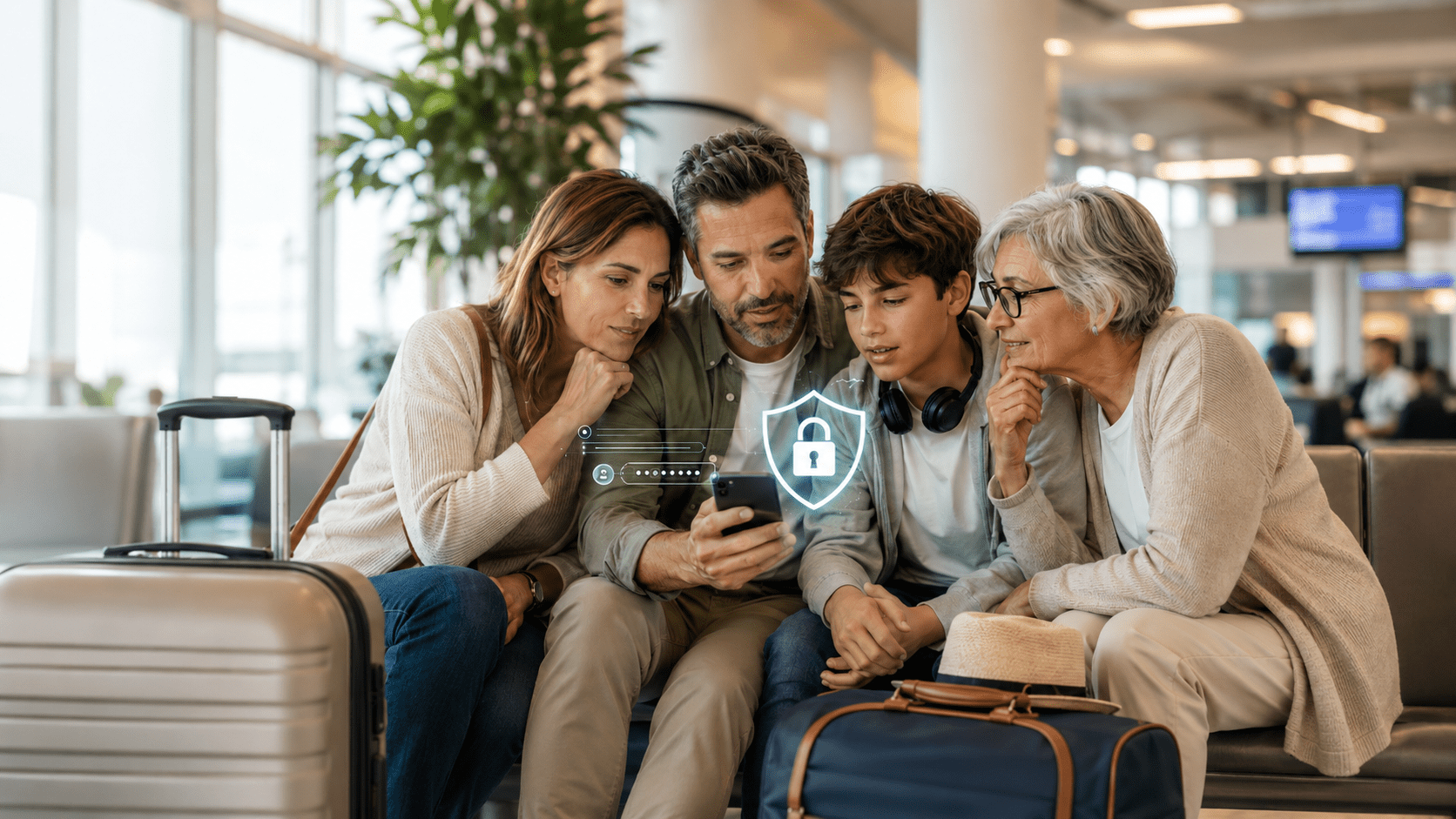

This is the English version of our Portuguese guide. Ler em português.

When we prepare a family trip, we think about flights, the hotel, documents, insurance and what to pack.
But there is another piece of preparation that often gets forgotten: digital security.
Protecting your family from digital scams
Today, a large part of any trip happens through the phone. We receive booking confirmations, make payments, open maps, chat on WhatsApp and store important documents in the cloud.
That dependence makes life much easier, but it also creates openings for scams that look more convincing every year.
You do not need to be distracted or uncomfortable with technology to fall for a fraud. Many of these messages are built to create urgency, fear or trust.
The goal should not be to live suspicious of everything. It should be to create a few simple rules that let the family pause, confirm and decide calmly.
Scams are no longer easy to spot
For many years, we associated phishing with poorly written emails, with obvious mistakes and requests that were hard to believe.
That has changed.
A fraudulent message can now:
- show a family member’s name;
- copy the look of a bank or company;
- refer to a booking or a trip;
- ask for a payment that looks small;
- use a real photograph;
- imitate the voice of someone close;
- create a sense of urgency.
A common example is a WhatsApp message:
“Hi Mum, this is my new number. My phone broke and I need you to pay for something urgently.”
Another scenario that can happen during a trip is receiving a message that appears to come from the hotel, the airline or a booking platform, asking you to confirm details or make an extra payment.
When we are busy, tired or out of our usual routine, it is easier to act without checking.
Who is most exposed in the family?
The most vulnerable people are not necessarily those who know the least about technology.
They can be:
- parents or grandparents who quickly trust a message that uses a relative’s name;
- teenagers used to clicking links quickly;
- people under pressure or short on time;
- family members who do not know how banks operate;
- travellers with network, battery or account-access problems;
- anyone faced with an emotionally urgent situation.
That is why protection should be organised as a family rule, not as an individual responsibility.
Create a family code word
One of the simplest measures is to agree on a secret word or question known only to the close family.
It can be used when someone:
- asks for money from an unknown number;
- claims to have lost their phone;
- calls asking for help;
- sends an unusual message;
- appears to be in an emergency.
The word should not be a name, a date of birth, a pet’s name or any other detail available on social media.
Faced with a suspicious request, simply ask for the code word or contact the person through a number you already know.
Want to put these measures in place at home?
The Família Blindada 2026 kit includes a practical guide, printable checklists, a family confirmation protocol and an SOS plan for reacting to a possible fraud.
Never confirm a request on the same channel
A particularly useful rule is confirmation through a second channel.
For example:
- a request arrived on WhatsApp: confirm with a call;
- an email arrived from the hotel: contact the hotel directly;
- a message appeared from the bank: open the official app;
- someone asked for money from a new number: call the old number;
- a suspicious QR code appeared: look up the official address yourself.
The principle is simple:
Whoever starts the contact should not also control how we confirm their identity.
Specific precautions before you travel
Before you leave, it is worth reviewing a few points with the whole family. The same preparation mindset that helps you decide when to book holiday flights also applies to digital security.
Update your devices
Installing pending updates on the phone, computer and apps reduces known vulnerabilities.
Turn on extra authentication
The main email account, bank accounts and the services where bookings are stored should have multi-factor authentication.
Save important contacts
It is useful to have on hand:
- the bank’s number;
- the insurer;
- the airline;
- the hotel;
- the mobile operator;
- emergency contacts;
- the embassy or consulate, when applicable.
These numbers should come from official pages, not from links received in a message.
Make copies of documents
Documents can be stored in a secure, protected location that remains accessible if the phone is lost.
Avoid, however, keeping photos of bank cards or access codes in the device gallery.
During the trip: less haste, more confirmation
The moments of greatest vulnerability often appear when something goes wrong.
A flight is cancelled, the booking does not show up, a card is declined or someone loses network coverage.
In those situations, any message that promises to solve the problem quickly looks more credible.
A few practical rules:
- do not make payments through unexpected links;
- do not share codes sent by SMS;
- do not install apps suggested by strangers;
- avoid banking on public Wi-Fi;
- confirm IBAN changes by phone;
- be wary of requests that demand secrecy or urgency;
- do not allow remote access to the phone or computer.
A legitimate institution does not need the code you received by SMS to “cancel a fraud”. That code usually authorises a transaction.
What if someone has already replied or transferred money?
The most important thing is to act quickly and without blaming the person.
Someone who falls for a scam may feel ashamed and hide what happened, delaying the response.
The first steps should include:
- contact the bank immediately;
- try to cancel or block the transaction;
- change compromised passwords;
- end open sessions;
- block cards when needed;
- keep messages, numbers and receipts;
- report it to the authorities;
- warn other family members who may be contacted.
The priority is to limit the damage. The discussion of how it happened can wait.
Digital security is part of the trip too
Protecting the family does not mean teaching everyone to identify every fraud in technical detail.
It means building simple habits:
- pause;
- be suspicious of urgency;
- confirm on another channel;
- never share codes;
- ask for help before paying.
Just as we check passports and insurance before travelling — and just as weather disruptions like Tropical Storm Bertha in Florida remind us that travel safety is broader than packing lists — it is worth making sure the whole family knows what to do when an unexpected message arrives.
Because, often, a few minutes of confirmation are enough to avoid a problem that can follow us long after we get home. The same care that goes into planning a family week in Madeira should go into the digital side of the trip.
Protect your family with a simple plan
Família Blindada 2026 was created to help parents, grandparents, children and relatives less used to technology recognise suspicious requests and know how to react.
It includes a 19-page guide, checklists, an emergency card and a plan for the first 24 hours after a possible fraud.

Leave a Reply