
This post contains affiliate links. If you book through them we may earn a small commission, at no extra cost to you. More in our Affiliate Disclosure.
We were on our way from Kyoto to Tokyo, riding one of those bullet trains that makes the Japanese countryside blur into watercolour, and we’d carved out a night and a day to break the journey in the mountains. No grand expectations. Just a ryokan, a hot spring, and a transport loop that promised views of Mount Fuji if the weather cooperated.
What we got was one of the best days of our Japan trip.
Not the most culturally rich (that was Kyoto). Not the most exciting (Tokyo, easily). But the day that gave us the clearest picture of what Japan feels like when you step away from the mega-cities — quieter, stranger, more beautiful than any guidebook photo had suggested.
Yoshiike Ryokan — The Garden, the Robes, and the Dinner We’d Never Order Again
We checked into Yoshiike Ryokan in Hakone-Yumoto and immediately understood why people travel to Japan specifically for this.
The ryokan has a traditional Japanese garden inside — not a token courtyard, but a proper, contemplative space with manicured trees, stone paths, and water features that you could sit and watch for an hour. Our room had tatami floors and those thin Japanese futon mattresses laid directly on the ground. The kids thought we were joking. By morning, everyone slept better than they had in any hotel bed.

The best part was the yukata — traditional Japanese robes that you wear around the ryokan, to dinner, to the onsen, everywhere. There’s something about a family of four shuffling around in matching robes and wooden sandals that breaks down every pretence. We looked ridiculous. We loved it.
And then came dinner.
The traditional ryokan kaiseki dinner is a production. Course after course of small, beautifully arranged dishes — raw fish, simmered vegetables, grilled things we couldn’t identify, rice, soup, pickles. It kept coming. The presentation was exquisite, the experience was genuinely memorable, and I need to be honest here: the food itself wasn’t for us. Some of it was challenging to eat (textures, flavours, things-with-eyes-still-attached), and by the end we were full of food we wouldn’t choose to order again.
Would I recommend the experience? Yes, absolutely — once. It’s cultural immersion at its most intimate, and you’ll talk about it for years. Would I eat it again? Probably not. And that’s the honest answer you won’t find in most travel blogs.
What we paid: one night (5–6 April 2026) in a Japanese-style garden-side room in the main building (10 tatami plus an engawa veranda), dinner and breakfast included, for four adults: €703.78 in total, about €176 per person. The local hot spring tax (¥150 per adult) was charged separately at the ryokan. It sounds steep, but it includes two full meals, the robes, the onsen and the whole experience, not just a bed. Book early for cherry blossom season: we booked in mid-January. We first held a room through Booking.com, then cancelled it and booked directly on the ryokan’s own website, which is the booking we used.
The Best Gluten-Free Burger in Japan (Maybe Anywhere)
This is the bit I wasn’t expecting to write.
As someone with coeliac disease, I’m used to eating carefully in Japan — and it’s actually one of the easiest countries for gluten-free travel thanks to rice being the foundation of almost everything (I wrote about that in our Japan overview post). But finding something that feels like a treat rather than a safe option? That’s rare.
Enter Box Burger in Hakone.
We stumbled on it hungry and hopeful, and what I got was — without exaggeration — the best gluten-free hamburger I’ve ever eaten. Proper bun, proper burger, properly delicious. The only catch: it’s a Japanese-style restaurant, which means you’re sitting on the floor. With European legs. For an entire meal. My knees still haven’t fully forgiven me, but the burger was worth every minute of discomfort.
If you’re coeliac and travelling through Hakone, Box Burger is a mandatory stop. I’d go back to Hakone just for this. One honest caveat: the gluten-free version is a rice-flour bun made in a shared kitchen (fries share the fryer area), so if you are highly sensitive, ask the staff about cross-contamination before you order.
Eating Gluten-Free Beyond Box Burger
A few other things that worked for us in Hakone:
The ryokan breakfast at Yoshiike was naturally rice-based — grilled fish, pickled vegetables, miso soup, tofu, and rice. If you are coeliac, tell the ryokan about the allergy when you book and again at check-in, and ask about the soy sauce: standard soy sauce contains wheat, so ask whether a wheat-free tamari is available.
At Owakudani (the volcanic area — more on that below), the famous black eggs are naturally gluten-free. The snack shops sell rice crackers and grilled items too, though check for soy sauce marinades.
Our tip: Bring your allergy translation card in Japanese. We used one throughout the trip and it worked every time. In Hakone’s smaller establishments, staff were actually more accommodating than in the big city chains — they knew exactly what was in their food because they made it themselves.
The Hakone Loop — Trains, Gondolas, and a Pirate Ship
The classic way to see Hakone is the Hakone Loop — a circuit that takes you through the area using a different mode of transport for each leg. We bought the Hakone Freepass and did the whole thing in a day.
The pass covers:
- The Hakone Tozan Railway — a switchback mountain train that climbs through forest
- The Hakone Tozan Cable Car — a funicular up to Sounzan
- The Hakone Ropeway — an aerial gondola over the volcanic valley and down to Lake Ashi
- The Lake Ashi sightseeing cruise — on a pirate ship, of all things
- Several bus routes around the area
It sounds like a lot. It is a lot. It was an intense day but a brilliant one, and the variety of transport keeps teenagers engaged in a way that yet-another-temple doesn’t. Each leg shows you a completely different side of the landscape.

Tip: Sort the Freepass before heading into Hakone (we bought ours on Klook; you can also buy it at Odawara or Shinjuku Station). In 2026 a 2-day pass costs ¥7,100 for adults and ¥1,600 for children from Shinjuku, or ¥6,000 and ¥1,500 if you buy the Hakone-area-only version at Odawara (prices went up in October 2025). Whether it actually saves money depends on your route: we worked it out line by line in Is the Hakone Freepass worth it for a family of four?
Owakudani at 1,044 Metres — A Lunar Landscape
The ropeway drops you at Owakudani, the active volcanic zone at 1,044 metres altitude, and stepping out feels like arriving on another planet. Steam rises from sulphur vents across a barren, grey-brown landscape. Nothing grows. The air smells of rotten eggs. It’s magnificent.


The main event is the kuro-tamago — black eggs boiled in the volcanic hot springs. The shells turn jet black from the sulphur, but the egg inside is perfectly normal and surprisingly tasty. Legend says each one adds seven years to your life. We each had one. Obviously.
Even if you skip the eggs, the landscape alone is worth the stop — twenty minutes of staring at something that looks nothing like the rest of Japan.
Note: Owakudani occasionally closes when volcanic activity increases. Check conditions before visiting.
Lake Ashi and the Pirate Ship
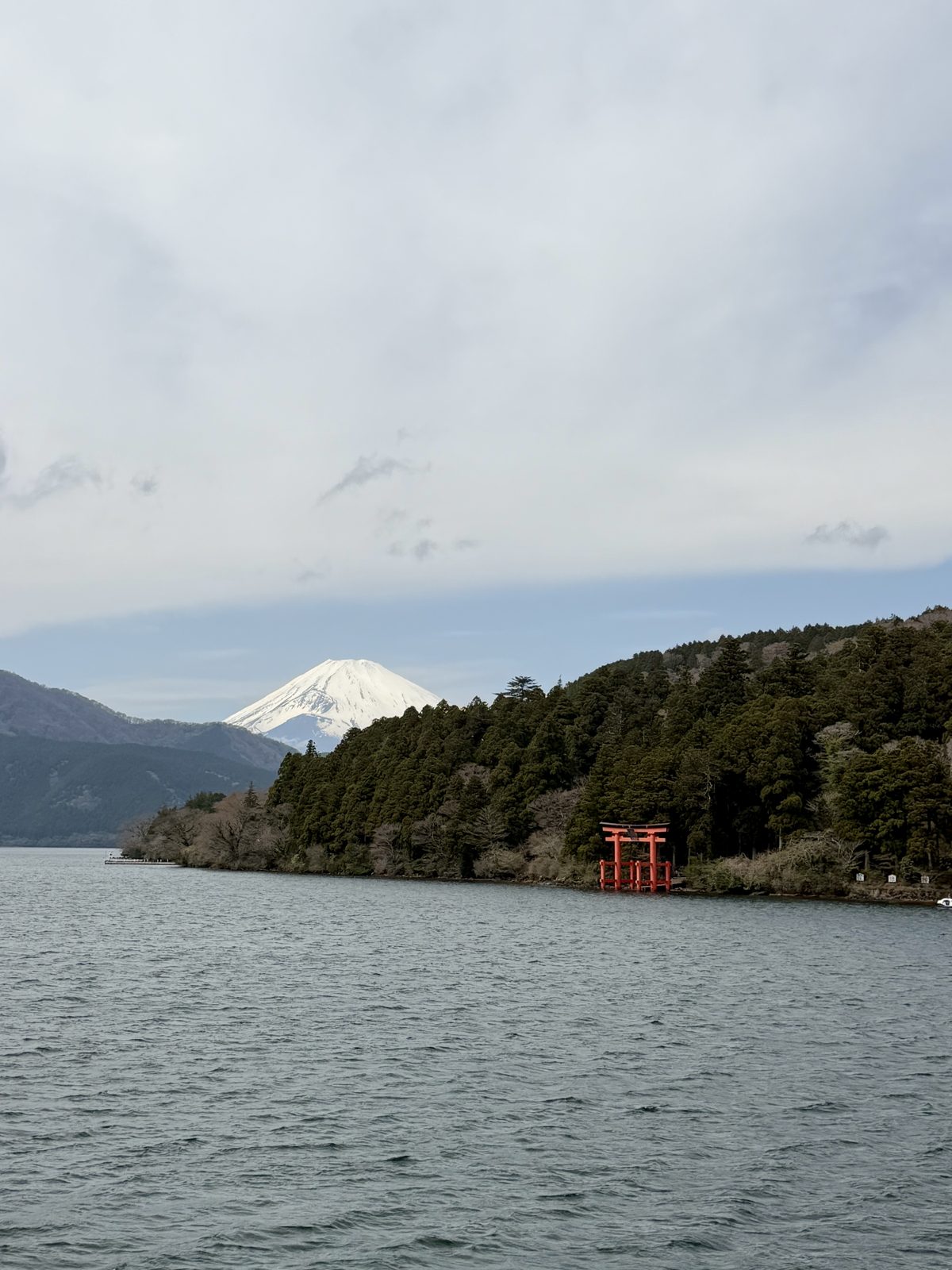
The Lake Ashi cruise is part of the loop, and it’s beautifully absurd. The sightseeing boats are designed to look like 17th-century pirate galleons — gilded, dramatic, completely over the top. The teenagers rolled their eyes getting on and spent the entire crossing on the upper deck photographing Mount Fuji reflected in the water.

And there it was — Mount Fuji. Visible in the distance, snow-capped, impossibly symmetrical against a clear April sky. Everyone on the boat went quiet for a moment. Phones came out. Then phones went down. Then everyone just looked.

That’s the moment the title of this post comes from. Not a dramatic summit climb, not a close-up encounter. Just a mountain, seen from a pirate ship, making a boatload of people stop talking.
Reality check: Fuji is famously shy — cloud cover hides it more often than not, especially in summer. We visited in early April and got lucky with a clear day. If seeing Fuji matters to you, aim for winter or early spring and go early. Morning light is best; the clouds roll in by midday.

From the southern shore, it’s a short walk to Hakone Shrine — set in ancient cedar forest with a famous torii gate standing in the lake. Worth a stop, but get there early if you want photos without crowds.

Getting to Hakone
We came from Kyoto on the Shinkansen (bullet train) to Odawara Station: the Hikari 642, leaving Kyoto at 08:33 and arriving at 10:38, so just over two hours (the Japan Rail Pass covers this leg if you have one). From Odawara, the local Hakone Tozan line takes you into the mountains. From Tokyo, the Odakyu Romancecar runs directly from Shinjuku to Hakone-Yumoto in about 85 minutes. We did it in reverse at the end: the Romancecar from Odawara at 17:10, arriving in Shinjuku at 18:28.
Luggage tip: Send your big bags ahead to your Tokyo hotel via takkyubin (luggage forwarding, available at any convenience store or hotel front desk). Travel to Hakone with just a day bag. This was a game-changer — you don’t want to be dragging suitcases onto cable cars and pirate ships.
How Many Nights?
We spent one night and it was enough to do the full loop, the ryokan experience, and catch Fuji. If I went back, I’d do two — one for the sightseeing, one for hiking and properly soaking in the onsen. Hakone has great walking trails, including hikes up Mount Kintoki with panoramic Fuji views from the summit.
With kids, one night works if your schedule is tight. Two nights is more relaxed and lets you properly decompress between the intensity of Kyoto and Tokyo.
Practical Tips
- Best season: Late March to mid-April (cherry blossoms + clearest Fuji views), or November (autumn foliage). Summer is hot, humid, and Fuji hides behind clouds.
- Photography: Morning light is best for Fuji. I shot everything on the Fujifilm X100VI and the Fuji colour rendering felt almost too perfect for this landscape.
- Onsen etiquette: Tattoos are traditionally not allowed in public onsen. If anyone in your group has tattoos, look for a ryokan with private baths (kashikiri-buro) and check the policy with the ryokan before booking.
- Floor seating: Many restaurants in Hakone use traditional floor seating (zashiki). If that’s difficult for you, ask for a table — some places have both options.
Book Activities Before You Go
Japanese tourism websites are notoriously difficult to navigate in English, and ticket counters can have long queues during cherry blossom season.
We used Klook (affiliate link) to pre-book the Hakone Freepass, our Shinkansen and Romancecar seats, and several experiences across Japan (observation decks, teamLab). Everything was on our phones, no printing needed, and it saved us real time and stress. If you’re planning Hakone, sort your passes through Klook before you fly — it’s one of those small decisions that makes the whole trip smoother.
Was Hakone Worth It?
Completely.

Hakone gave us the ryokan — futons on tatami, matching robes, a garden that belonged in a film. It gave us Owakudani — a volcanic moonscape at a thousand metres. It gave us the best gluten-free burger either of us has ever eaten (sitting on the floor, knees aching, not caring at all). It gave us a pirate ship, and from that pirate ship, it gave us Mount Fuji.
But more than any single thing, Hakone gave us perspective. After days in Osaka, Kyoto, and the sensory overload of Japanese cities, this one night in the mountains reminded us that Japan is also quiet valleys, steaming earth, and a sacred mountain that makes strangers go silent.
Go. Even if your itinerary feels full. Even if it’s just one night. Go.
This is part of our Japan series — a 13-day family trip covering Osaka, Nara, Kyoto, Hakone, and Tokyo during cherry blossom season. Next up: Tokyo, the city we tried to see in four days and will spend the rest of our lives finding excuses to go back to.
Frequently Asked Questions
Is Hakone worth visiting with kids?
Absolutely. The variety of transport (train, cable car, ropeway, pirate ship) keeps children engaged, Owakudani feels like visiting another planet, and the ryokan experience is something they’ll remember. Our teenagers rated Hakone as their favourite stop outside Tokyo.
Can you do Hakone as a day trip from Tokyo?
You can, and many people do. But staying overnight in a ryokan is half the experience. If you only do a day trip, you’ll see the loop but miss the onsen, the kaiseki dinner, and the quieter morning moments. One night makes a real difference.
Is Hakone gluten-free friendly?
More than we expected. Ryokan meals are naturally rice-based, Box Burger does an incredible gluten-free hamburger, and the smaller restaurants are surprisingly accommodating. Bring a Japanese allergy card and you’ll eat well.
When is the best time to see Mount Fuji from Hakone?
Winter and early spring offer the clearest views — cold, dry air means less cloud cover. We visited in early April and had a perfect day. Summer is the worst for visibility. Go early in the morning regardless of season.
Keep reading: Is the Hakone Freepass worth it? (the maths) · Kyoto with teenagers · Tokyo in four days · Japan gluten-free trip with teenagers (overview)
⚠️ Gluten-Free Disclaimer
The food and restaurant recommendations on this blog reflect our personal experiences at the time of our visit. Menus, ingredients, and kitchen practices change — we cannot guarantee that any establishment remains safe for coeliacs or people with gluten intolerance. Always verify allergen information directly with the restaurant before ordering. For full details, please read our Gluten-Free Content Disclaimer.

Leave a Reply