
This post contains affiliate links. If you book through them we may earn a small commission, at no extra cost to you. More in our Affiliate Disclosure.
The Leica Q (Typ 116) is a full-frame compact with one lens that cannot be changed: a Summilux 28mm f/1.7. For travel that sounds like a limit, and it is also the whole point of the camera. This post looks at what that lens does, using twelve frames from the Q taken in Dublin, Galway and at the Cliffs of Moher on 14 and 15 September 2018, with the exposure settings read from each file’s EXIF data.
One honest note on the photos: they are edited files (the EXIF Software field reads Alien Skin Exposure X3), so they show what the lens and sensor can do, not straight-out-of-camera JPGs. Over the years I have owned three Leicas: the original Q, an M240 and an M11. I loved all three. If you want the three-way comparison, it is in Leica Q vs M240 vs M11 for Travel. The interchangeable M lenses I used on the M240 and the M11 are in Leica M Lenses for Travel: 35mm vs 50mm vs 90mm (Real-World Picks).

The short answer
- Why it works for travel: one body, one lens, nothing to swap. Autofocus, optical image stabilisation, an electronic viewfinder and a macro mode that focuses from 17 cm are all built in (Leica technical data).
- What you give up: you live at 28mm. The digital crop modes give you the equivalent of 35mm (4800 × 3200 pixels) or 50mm (3360 × 2240 pixels), but at a lower pixel count than the full 6000 × 4000.
- Weather: the Camera Decision review notes that the original Q has no environmental sealing on its body, so rain and dust call for care.
Leica Q (Typ 116): the specs that matter on the road
All figures come from Leica’s own Q (Typ 116) technical data PDF, except the weight, which is the figure already quoted in our comparison post.
| Sensor | Full-frame CMOS, 24.2 MP effective, 14-bit |
| Lens | Leica Summilux 28mm f/1.7 ASPH., 11 elements in 9 groups, 3 aspherical |
| Aperture range | f/1.7 to f/16 |
| ISO | Auto, 100 to 50,000 |
| Shutter | Mechanical 30 s to 1/2000 s; electronic up to 1/16,000 s |
| Focus | Autofocus or manual; 30 cm to infinity, macro from 17 cm |
| Stabilisation | Optical, for photos and video |
| Viewfinder and screen | 3.68 MP electronic viewfinder; 3-inch touchscreen, about 1.04 million pixels |
| Digital crop | 35mm equivalent (4800 × 3200 px) and 50mm equivalent (3360 × 2240 px) |
| Weight | 640 g with battery |
What a fixed 28mm f/1.7 looks like in practice
A 28mm lens on a full-frame sensor sees roughly 75 degrees diagonally, which is wide enough to take in a building and the street in front of it. The frames below are grouped by what the lens was doing, and every setting is the one recorded in that frame’s EXIF.
Streets, bridges and rivers (14 September, Dublin). These three frames were all taken at f/8 or f/11 and ISO 800, at shutter speeds from 1/160 s to 1/2000 s. In the townhouse frame most of the façade fits in the frame, from the pavement up, and the bridge frame keeps the arch, the Georgian buildings behind it and the water in one picture.


Wide open at f/1.7. The coffee cup and the back bar were both shot at f/1.7, the lens’s widest aperture. In the cup frame, the table and the background fall away into blur. The cup frame is also at 1/2000 s, which is the fastest speed of the mechanical shutter according to Leica’s data sheet.


Dim interiors. The hotel dining room was shot at f/2.8 and 1/40 s, still at ISO 800. For reference, the old rule of thumb for hand-held shooting is a shutter speed of at least 1/focal length, which for a 28mm lens is about 1/28 s.

The Docklands and the road. The Docklands frame is 1/1250 s at f/8. The motorway frame, taken from inside a car on 15 September, is 1/1600 s at f/8.


Galway (15 September). Both Galway frames are at f/8. The quay frame is 1/2500 s, a speed beyond the mechanical shutter’s 1/2000 s limit, so by Leica’s specification that frame must have used the electronic shutter, which goes up to 1/16,000 s.


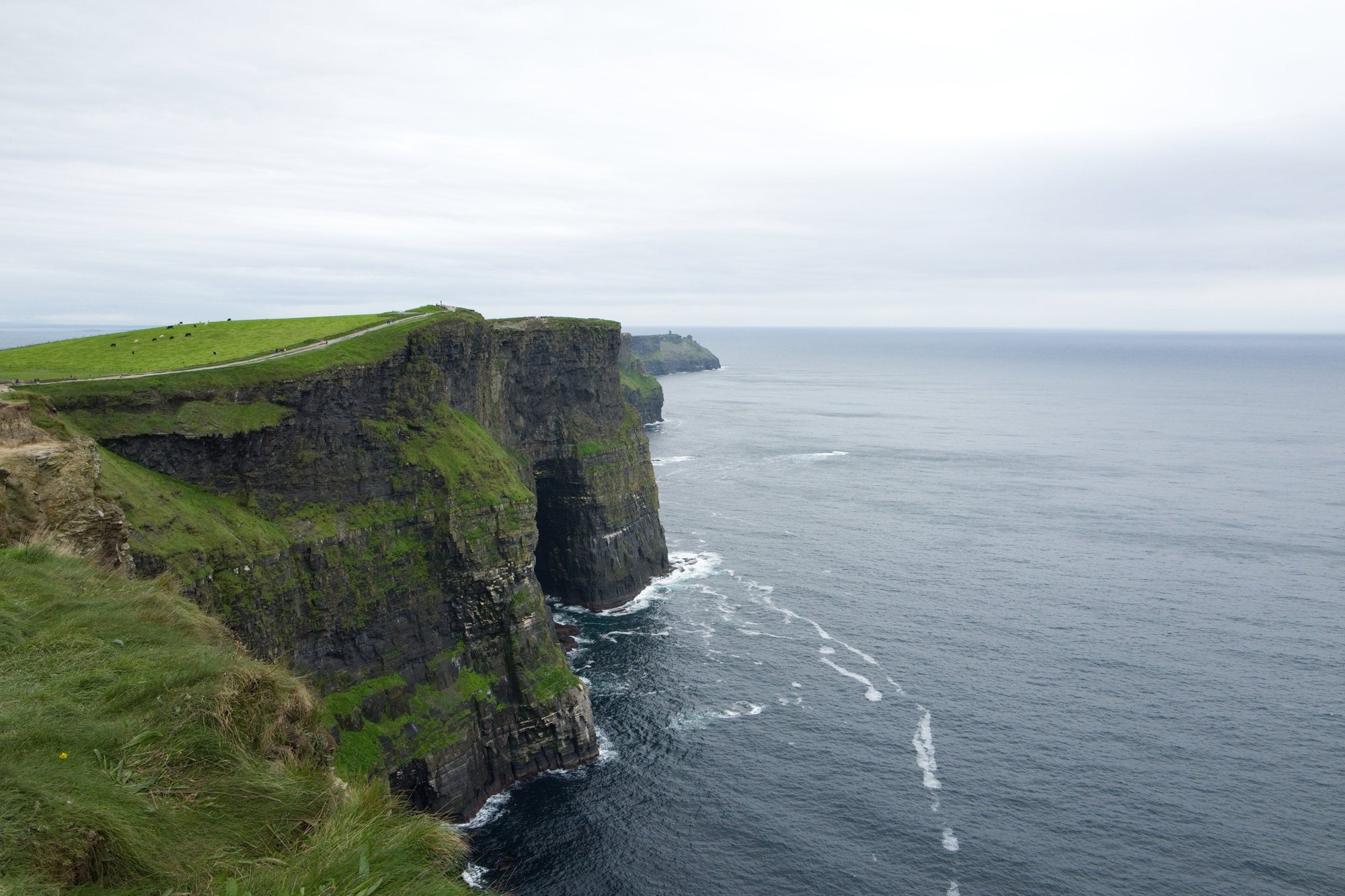
The Cliffs of Moher (15 September, about 17:55). The landscape frame at the top of this post and the vertical frame below are both f/8. At 28mm the cliff, the sea and a lot of sky fit in one frame. The distant sea stack in the vertical frame is small in the picture, which is the trade-off of a fixed wide lens: to fill the frame with a far-away subject you would crop in the camera (the 35mm and 50mm modes) or in editing.

Buying a used Leica Q (Typ 116): what to check
The Q (Typ 116) was announced in 2015, so most people looking at one today are looking at a used body. The lens is fixed to the body, so a problem with it can’t be fixed by swapping lenses. These checks come up repeatedly in community and retailer guides:
- Sensor dust. Stop the lens down to about f/8 to f/11, photograph a bright, even sky and look for specks. A thread on r/Leica says the Q (Typ 116) had a common dust issue and suggests deciding in advance whether you would service it or live with it.
- The lens. Check the front and rear elements, the aperture ring, the focus ring and the macro mechanism, and that the lens feels firmly attached to the body. Test autofocus at several distances and in both normal and macro mode (Roter Punkt Kamera, in German, and the r/Leica thread).
- Viewfinder, screen and controls. Look for sharpness and flicker in the viewfinder, set the diopter, test the touchscreen and every dial and button (Bastian Peter, in German).
- Battery, charger and accessories. An original battery and charger, the lens cap and hood, the box and the paperwork all add confidence in the seller (same guide).
- Shutter count. It is not stored in the DNG files. ShutterCount advises having it read on the camera during an inspection, or asking Leica Customer Care, rather than trusting a number quoted by the seller.
- A return window. The Leica Society International recommends insisting on a money-back guarantee of at least 30 days when buying any used Leica.
For used prices, our comparison post lists copies of the Q (Typ 116) on MPB as I checked them on 13 November 2026; prices change, so check the current listings and the warranty.
Visiting Dublin and the Cliffs of Moher
If you would rather not drive to the west coast, GetYourGuide lists a full-day coach tour from Dublin that covers the Cliffs of Moher, the Burren and Galway city. The listing gives the duration as about 13 hours and recommends bringing a packed lunch. Check dates, price and the current details on the listing itself: From Dublin: Cliffs of Moher, Burren and Galway City Day Tour (affiliate link).
For somewhere to stay, you can search Dublin hotels on Booking.com (affiliate link).
Which Leica for travel?
My own preference is simple: if I had to pick the camera whose JPGs I like most straight out of camera, it would be the M240, not the M11. That is a personal preference, not a lab test. The Q is the easy one: autofocus, one lens and nothing to decide. If you want the rangefinder route, I wrote longer notes on the M240 in Leica M240 in 2026: Is It Still Worth It as a Travel Camera? and on the M11 in Leica M11 for Travel Photography. Whatever you carry, the habits matter more than the body, and our 10 travel photography tips work with any camera.
Keep reading
- Leica M Lenses for Travel: 35mm vs 50mm vs 90mm (Real-World Picks)
- Leica Q vs M240 vs M11 for Travel: Which One Should You Choose?
- Leica M240 in 2026: Is It Still Worth It as a Travel Camera?
- Leica M11 for Travel Photography: Honest Notes from Real Trips
- Travel photography tips for beginners
Sources
- Leica Camera: Leica Q (Typ 116) technical data (PDF)
- Camera Decision: Leica Q review
- r/Leica: Buying a used Q (Type 116)
- Roter Punkt Kamera: Leica Q buying guide (German)
- Bastian Peter: Leica Q gebraucht kaufen (German)
- ShutterCount: Leica Q (Typ 116) shutter count
- Leica Society International: Buying used Leicas on eBay
Leave a Reply